Robotaxis Are Already on the Road.
Are They in Your Travel Policy?
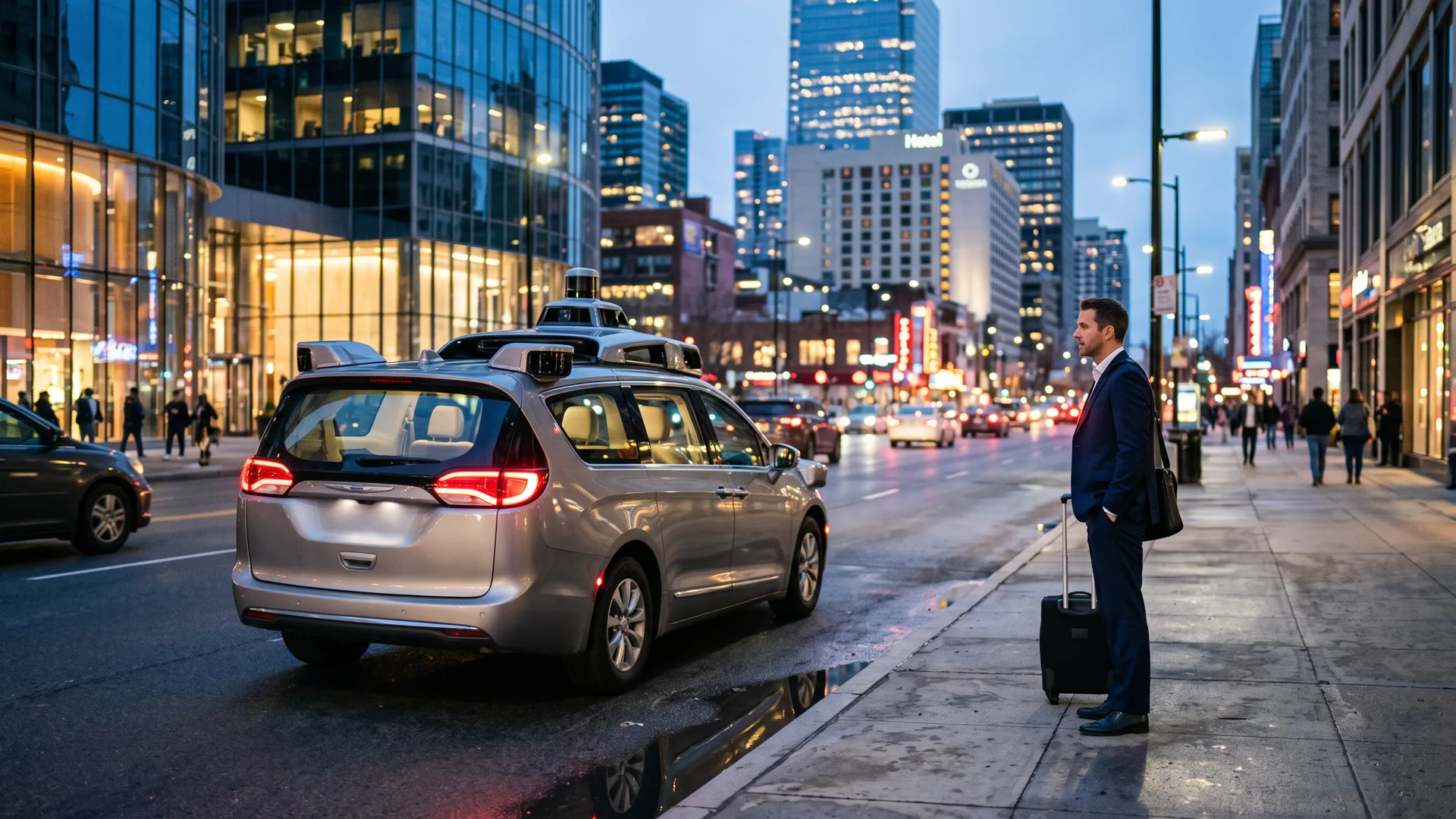
Autonomous ride-hailing is no longer a pilot program or a distant promise. Waymo now completes more than 500,000 paid rides per week across 15 U.S. metropolitan areas. Zoox launched paid driverless service in Las Vegas in August 2026. Tesla deployed its Cybercab in Austin in September. Meanwhile, in May 2026, the National Highway Traffic Safety Administration opened a formal investigation — PE26003 — into Avride after 16 crashes in Dallas and Austin. Most corporate travel policies still classify all ride-hailing under a single "rideshare" category, with no distinction between a human driver and a fully autonomous system. That gap is a duty-of-care failure waiting to happen.
The Policy Gap: Why "Rideshare" Is No Longer Enough
Traditional ground-transport rules assume a human driver — and that assumption is now wrong
Is the ride fully driverless, supervised, or experimental?
Avride's service in Dallas uses a human safety operator in the driver's seat — it is not equivalent to Waymo's fully driverless operation. A policy that permits "rideshare" may unintentionally authorize supervised pilots or newly launched driverless services without review.
Does the provider have regulatory authorization in that city?
California requires DMV permits and PUC authority. Texas permits operation without a special state AV permit when federal requirements and liability coverage are met. Arizona uses an executive-order model. Approval in one state does not transfer to another.
Who assists an employee during a medical event or collision?
There may be no person in the vehicle able to give first aid, help a traveler exit, assist with mobility needs, or interpret a police instruction. Remote assistance is not equivalent to an on-site driver. This is a material duty-of-care gap.
What happens when a fleet-wide software pause strands travelers?
In May 2026, Waymo paused freeway operations in some markets following construction-zone navigation issues. A software update or regulatory suspension can interrupt service across an entire fleet simultaneously — with no individual driver to call.
The 2026 Operator Landscape: Not All Robotaxis Are Equal
Each provider has a different operating model, safety record, and liability structure
Waymo
Paid, fully driverless public service
15 U.S. cities including Phoenix, San Francisco, LA, Atlanta, Austin, Dallas, Houston, Miami. ~4,000 vehicles, 500K+ rides/week. Most mature U.S. deployment. Freeway service paused in some markets in May 2026 after construction-zone navigation issues; phased restoration from July.
Avride
Supervised autonomous service — NOT fully driverless
Passenger service via Uber in Dallas since December 2025. Human safety operator in driver's seat during all 16 crashes under NHTSA PE26003 review. Operator intervened in only 1 of 16 events. Treat as a supervised emerging service while investigation is open.
Zoox
Paid driverless in Las Vegas; free/testing elsewhere
Paid Las Vegas service launched August 10, 2026. San Francisco rides remained free while state permissions were pursued. Austin and Miami in testing or limited free-use stages. 3M+ public-road miles, ~1M riders across footprint by August 2026.
Tesla
Mixed supervised and unsupervised — verify per market
Cybercab entered Austin fleet in September 2026; certification subject to NHTSA audit query. Activity also reported in Dallas, Houston, Miami, Orlando, Tampa, SF Bay Area. Do not infer uniform driverless capability across markets.
Cruise
No active robotaxi service
GM halted the robotaxi business in December 2024 after a serious pedestrian incident. No restart announced. Cruise should not appear as an available approved provider — but its history is a critical lesson in regulatory withdrawal risk.
Reading the Safety Evidence Correctly
Favorable statistics are real — but they must be bounded carefully
Waymo reported 82% fewer injury-causing crashes than human drivers across 270 million autonomous miles (operator-reported). An independent IIHS analysis found 68% fewer police-reportable crashes per vehicle mile — a meaningful independent benchmark.
Both figures apply within Waymo's specific operational design domain (ODD): mapped urban geographies, defined conditions. They do not establish universal safety across all conditions, providers, or markets.
NHTSA's Standing General Order requires reporting of crashes involving automated driving systems. Raw counts are not normalized for fleet size or miles traveled — a larger operator will report more events simply due to greater exposure.
Safety review must go beyond collisions. Emergency-scene interference, traffic obstruction, and inability to follow responder directions can create serious consequences without producing a conventional injury crash. In July 2026, NHTSA directed developers to submit remediation plans for robotaxi interference with emergency scenes.
Liability, Insurance, and the Evidence Chain
Responsibility does not simply transfer to a software company
Multi-party liability
A claim may involve the automated-system developer, vehicle manufacturer, fleet operator, maintenance provider, booking platform, another road user, or infrastructure conditions. Employer exposure is jurisdiction- and fact-specific but cannot be assumed away.
Insurance gaps
California requires at least $5 million in commercial liability coverage for robotaxi operators. But bodily-injury coverage may not reimburse missed flights, lost business, or non-refundable bookings. Cyber, errors-and-omissions, and business-interruption risks may sit in separate policies or remain uninsured.
Evidence preservation
Fault analysis may depend on event-data recorders, vehicle telemetry, camera and sensor feeds, remote-assistance communications, maintenance records, and software versions. After any material event, immediately request preservation from every relevant provider. Travelers must retain booking records, receipts, screenshots, and communications.
10-Point Corporate Approval Checklist
Apply before approving any autonomous ride-hailing service for business travel
Classify the service
Record whether it is paid driverless, supervised passenger service, free pilot, or testing. Do not treat all as equivalent.
Approve by operational design domain
Specify city, service zone, road type, operating hours, and any known weather or freeway limitations.
Verify regulatory standing
Confirm federal, state, and local authority. Monitor investigations, exemptions, restrictions, and suspensions.
Evaluate safety evidence
Review exposure-normalized data, injury outcomes, emergency interactions, transparency, and unresolved investigations.
Test emergency support
Confirm an in-vehicle emergency control, reachable remote assistance, and procedures for police, fire, and medical events.
Review insurance and contracts
Validate limits, financial capacity, exclusions, indemnities, platform relationships, and consequential-loss gaps.
Protect data
Assess cybersecurity, trip-data collection, retention, access, and corporate tracking integration.
Preserve accessibility and choice
Provide a human-assisted alternative without penalty for disability, safety concern, or personal discomfort.
Centralize booking and response
Use approved channels, capture real-time trip details, and establish a 24-hour incident-escalation path.
Review continuously
Reassess at least annually and immediately after a serious incident, regulatory action, or material service change.
Sample Policy Language
Employees may use a robotaxi for business travel only when the provider, city, and operating service are listed as approved by Corporate Travel and Security. Approval applies solely within the provider's authorized operational design domain and does not extend automatically to other cities, pilots, supervised services, or newly launched features. Employees may select a human-driven or human-assisted alternative at any time without penalty. Any collision, injury, immobilization, emergency-service interaction, or suspected cyber or privacy event must be reported immediately.
The question for corporate travel managers is not whether autonomous vehicles are categorically safe or unsafe — the evidence does not support a blanket conclusion either way. The question is whether your policy has kept pace with the service now being offered. Waymo is already completing half a million rides a week. Zoox launched paid service in Las Vegas last month. Tesla's Cybercab entered Austin this month. The policy gap is not theoretical. It is operational, and it is open right now.