
The Power Bank Reset
Updating Corporate Travel Policy for the 2026 Aviation Battery Rules
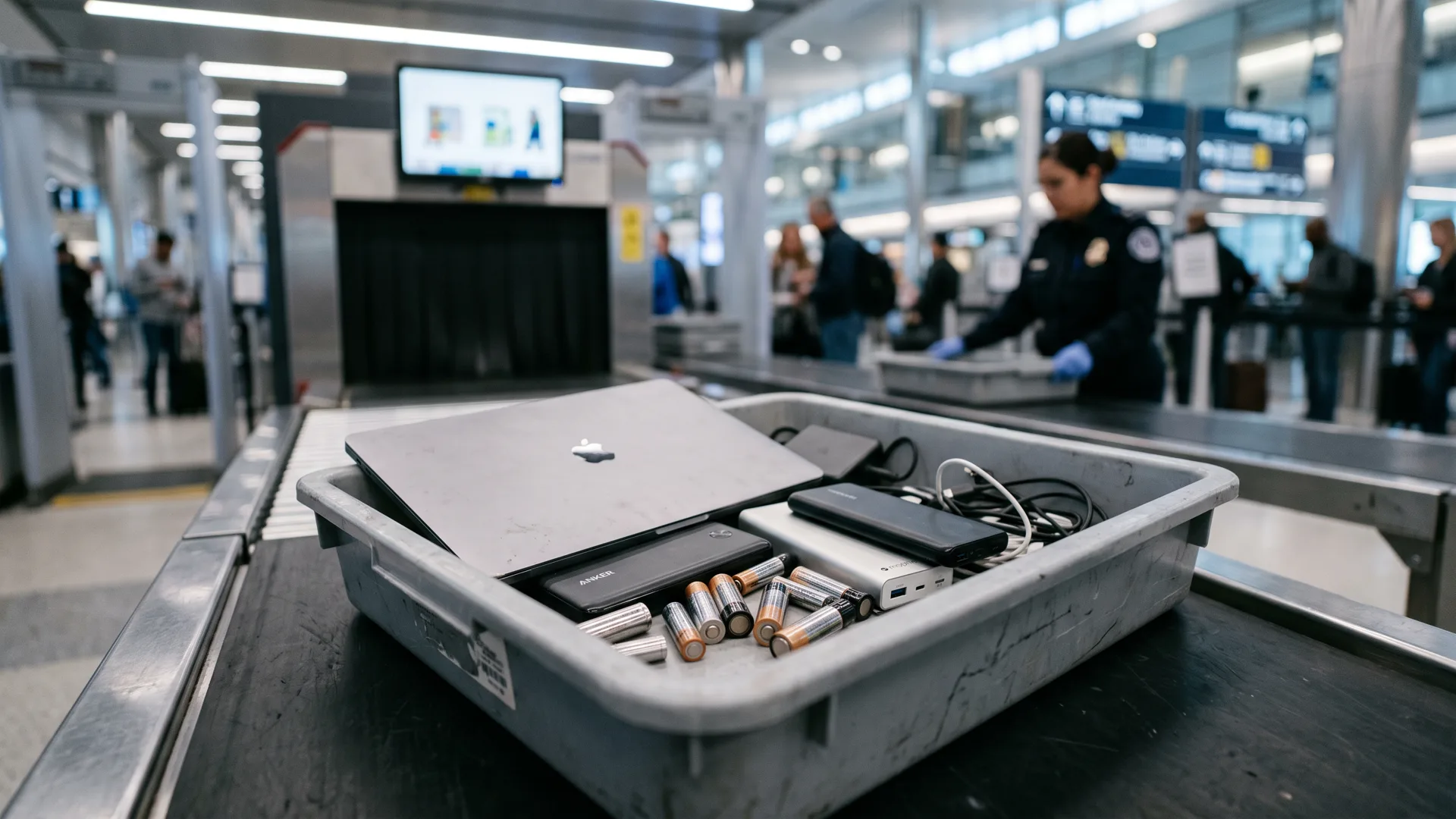
A quiet but consequential rule change took effect on 27 March 2026. ICAO's Addendum No. 1 to its 2025–2026 Technical Instructions introduced a hard two-power-bank limit per traveller, prohibited recharging power banks from aircraft power supplies, and recommended against using them to charge other devices in flight. The IATA Dangerous Goods Regulations 68th edition, expected from 1 January 2027, will codify a 100 Wh ceiling for power banks and reduce the general spare-battery allowance. For corporate travel managers, the window to update policy, equipment lists, and traveller briefings is now — before the next wave of enforcement surprises disrupts itineraries.
What Changed on 27 March 2026
Four key provisions from ICAO Addendum No. 1 to the 2025–2026 Technical Instructions
Two Power Banks Maximum
Each passenger or crew member may carry no more than two power banks. This is a new explicit limit — previously, the general spare-battery allowance applied. Airlines with stricter policies (e.g., Southwest Airlines' reported one-unit limit from April 2026) govern where they conflict.
Cabin Baggage Only — No Exceptions
Power banks must travel in cabin baggage. They cannot be placed in checked baggage under any circumstances. This applies even if the power bank is inside a bag that is subsequently gate-checked — remove it before surrendering the bag.
No Recharging from Aircraft Power
Recharging a power bank from an aircraft power supply (seat USB port or power outlet) is prohibited. The addendum also recommends against using a power bank to charge another device in flight. Corporate policy should treat the recommendation as a prohibition to avoid confusion with stricter carrier rules.
Individual Short-Circuit Protection Required
Each power bank must be individually protected against short circuit — terminals covered, stored in a protective pouch, or in its original packaging. Loose batteries in a bag pocket do not meet this requirement.
Capacity Rules at a Glance
Apply the strictest rule across all operating carriers and transit jurisdictions
| Item | Cabin | Checked | Capacity Limit | Onboard |
|---|---|---|---|---|
| Power bank / portable charger | Required — max 2 per person | Prohibited | ≤100 Wh (corporate ceiling); 101–160 Wh requires airline approval (avoid) | No recharging from aircraft power; avoid using to charge devices |
| Spare lithium-ion battery | Required | Prohibited | ≤100 Wh permitted; 101–160 Wh requires airline approval; >160 Wh forbidden | Keep terminals protected and battery accessible |
| Battery installed in device (phone, laptop, tablet) | Preferred | Generally permitted — device must be completely off, protected | ≤100 Wh permitted; 101–160 Wh requires operator approval; >160 Wh forbidden | Normal use permitted per airline policy |
| Smart luggage — removable battery | Permitted with battery installed | Bag may be checked only after battery removal | Removed battery treated as spare — cabin only | Prevent accidental activation |
| Smart luggage — non-removable battery | Subject to capacity and airline policy | Cannot be checked if battery exceeds small-battery thresholds | Avoid purchasing — creates foreseeable gate-check failure | Confirm acceptance before travel |
Airline and National Overlays
The strictest applicable rule governs — check every operating carrier
Southwest Airlines
Reported limit of one portable charger per passenger from April 2026; overhead-bin storage prohibited.
Issue only one power bank for Southwest itineraries; keep it accessible at the seat.
Air Busan
Prohibited power banks in overhead baggage following a January 2025 aircraft fire.
Keep power bank out of overhead compartment; follow crew storage instructions.
China (national)
Power banks lacking Chinese safety certification (CCC/CQC) or subject to manufacturer recall prohibited from 27 June 2025.
Verify certification marking on all power banks before travel to or through China.
South Korea (national)
Up to five portable batteries ≤100 Wh permitted; batteries >160 Wh prohibited.
Apply the ICAO two-unit limit as the binding corporate rule — it is stricter.
Why This Is a Duty-of-Care Issue
Thermal events are fast, severe, and increasingly common
89 FAA-Recorded Incidents in 2024
The FAA's lithium-battery incident database recorded 89 smoke, fire, or extreme-heat events on aircraft in 2024, with 38 more verified through June 2025. These figures cover reported US-oversight experience — the global total is higher.
Recalled Power Bank Explosion (February 2026)
A recalled Casely Power Pod reportedly exploded while charging a passenger's phone aboard an aircraft, causing first-degree burns. By April 2026, the associated recall included 28 additional reports of overheating, expansion, or ignition.
Air Busan Aircraft Fire (January 2025)
An Air Busan aircraft was engulfed in flames in January 2025. The incident prompted the airline to prohibit overhead-bin storage of power banks — a policy now in force for all passengers on that carrier.
Operational Disruption Beyond Injury
Non-compliant batteries may be confiscated at security or the gate, forcing baggage retrieval and repacking. Late discovery can cause offloading or denied boarding — disrupting meetings, connections, and traveller tracking.
Smart Luggage: Removability Is the Deciding Control
Non-removable batteries create foreseeable gate-check failures
- Battery must be removed before the bag is checked where it exceeds applicable thresholds.
- Removed battery travels in the cabin as a spare — terminals protected.
- If the bag stays in the cabin, battery may remain installed subject to capacity and airline rules.
- Gate-check prompt: remove power banks and spare batteries before surrendering the bag.
- Cannot be checked with the battery installed if it exceeds small-battery thresholds.
- Creates a foreseeable failure point when cabin baggage is gate-checked.
- Corporate procurement should ban non-removable-battery luggage now.
- Existing stock: confirm airline acceptance before every trip — do not assume.
Executive Multi-Device Protocol
For travellers carrying phone, laptop, tablet, headphones, and charging kit
Standardize the Kit
Carry one company-approved power bank ≤100 Wh. A second may be carried only when operationally necessary and every operating carrier permits it.
Charge Before Departure
Charge all devices and the power bank before leaving. Do not depend on recharging the power bank aboard the aircraft.
Create One Battery Pouch
Place each power bank and spare battery in its own protective pouch with terminals covered. Keep the pouch accessible — not buried in an overhead bag.
Keep Capacity Visible
Ensure the Wh rating and product identity remain legible. Do not carry damaged, swollen, unusually hot, recalled, or unidentifiable units.
Prepare for Gate Checking
Before boarding, ensure all spare batteries and power banks can be removed from the roller bag in seconds. Practice this before the first trip.
Escalate Immediately
If any device becomes hot, expands, emits an odour, smokes, or enters a seat mechanism — stop using it and notify cabin crew immediately. Do not move the seat.
30-Day Corporate Action Plan
Align policy, equipment, and communications before the 2027 IATA DGR takes effect
Set the Baseline
- Amend travel policy: two-unit maximum, 100 Wh corporate ceiling.
- Prohibit checked-baggage carriage and in-flight use or recharging.
- Identify travellers issued with power banks above 100 Wh.
- Suspend procurement of non-removable-battery smart luggage.
Control Equipment
- Create an approved-product list with visible Wh ratings.
- Check approved products against current recall notices.
- Issue individual protective battery pouches to frequent travellers.
- Replace damaged, swollen, recalled, or poorly labelled units.
Operationalize
- Add a battery check to online booking, pre-trip emails, and executive-assistant checklists.
- Build alerts for stricter airlines (Southwest, Air Busan) and national certification rules (China).
- Add a gate-check prompt: "Remove power banks and spare batteries before surrendering your bag."
- Train TMC and security teams on escalation procedures.
Test and Assure
- Run a tabletop scenario: gate confiscation and missed connection.
- Test an onboard overheating escalation with the security team.
- Audit frequent travellers' multi-device kits.
- Assign ownership for verifying the final IATA 68th edition before 1 January 2027.
The 2026 battery rules are not a compliance footnote — they are an operational reality that will strand travellers, disrupt itineraries, and expose organizations to duty-of-care liability if left unaddressed. The governing principle is straightforward: use the ICAO baseline as the floor, the strictest carrier or national requirement as the operational rule, and a conservative 100 Wh corporate standard to prevent airport disputes from becoming safety or continuity incidents. The window to act is now, before the 2027 IATA DGR edition closes the gap between best practice and binding regulation.